


- Choosing a selection results in a full page refresh.
FREE SHIPPING ON ORDERS OF SFR 100.- OR MORE & FREE RETURNS WITHIN CH/FL
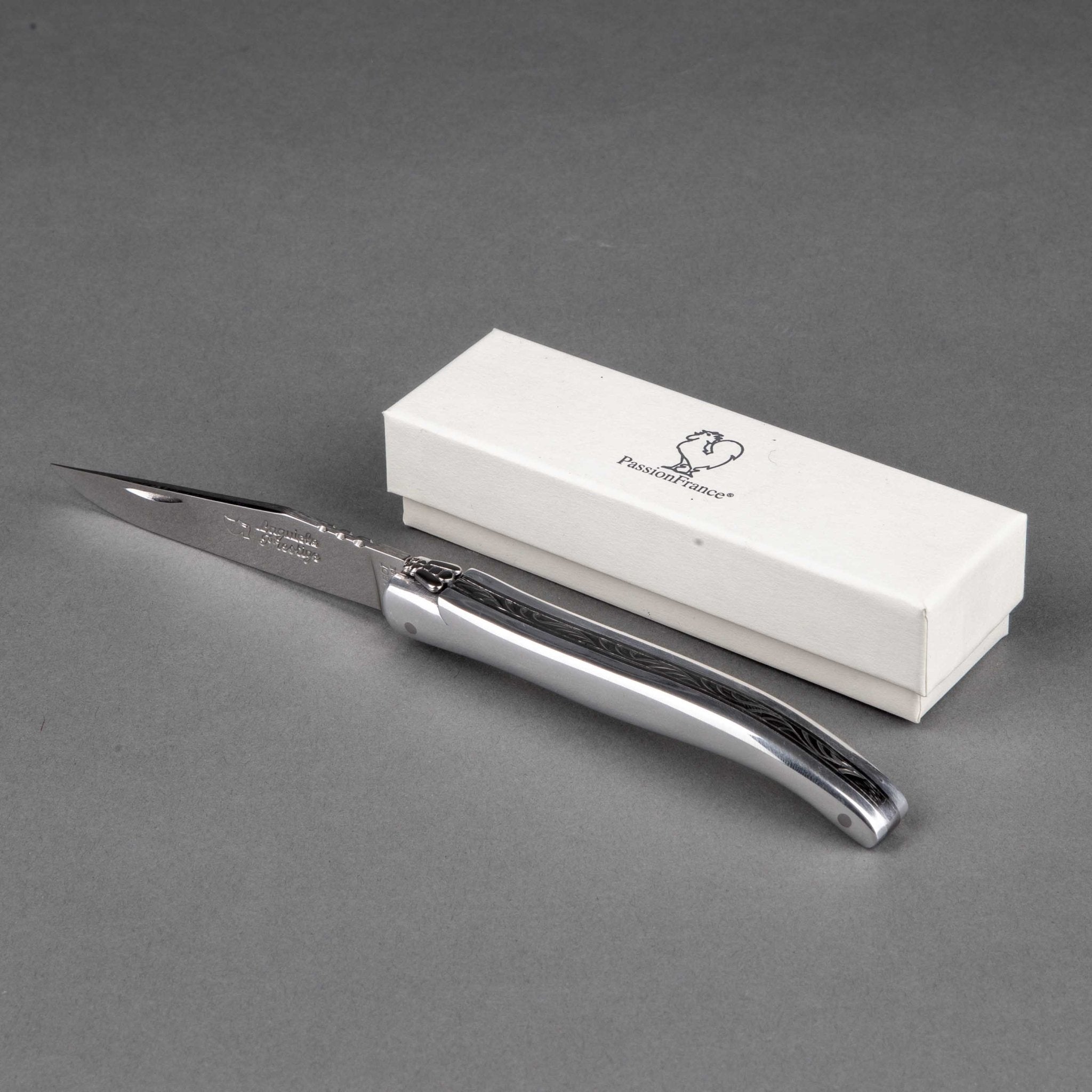
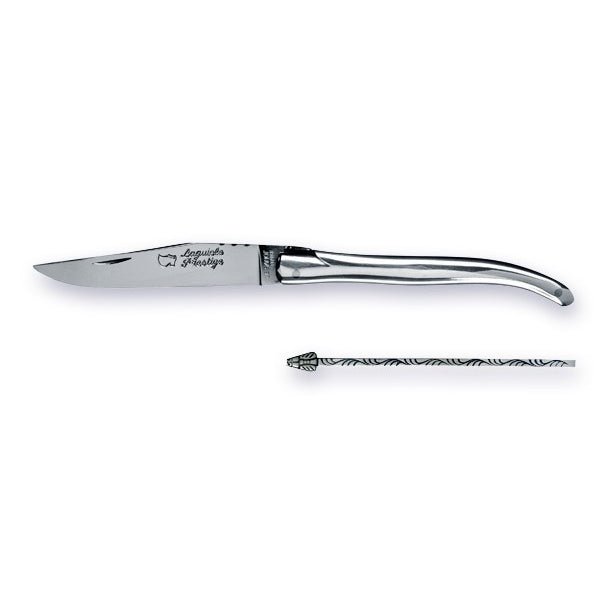
Compared to knives from other regions of France, the lines of a Laguioleare slim and elegant... unusually delicate for a knife that was at home in a farming environment, which consisted essentially of farmers and stockbreeders or routiers, who traveled through the country as traveling traders with their ox or donkey carts and traded in the products of their homeland.
One would think that knives for such a target group would not be as elegant as Laguioles are. But the surprising thing is that its slender handle fits so well in the hand and follows the contours of the hand so perfectly that it couldn’t be more sturdy.
It is also undisputed that, to date, none of France’s numerous knives have sparked such a debate among architects, designers, and creative people. A possible answer to this question likely lies in this special feature: its unusually elegant lines.
The story of the Laguioles has been passed down to us for years through the fairy tales and legends that circulate among the rural people of Aubrac, and how they came to be associated with blacksmiths. Once upon a time…
- In 1828, a young blacksmith named Pierre-Jean Calmels created a knife that soon became the most popular knife in France because of its slender lines, elegance, and balanced proportions.
- The Laguiole is a hybrid of the Capuchadou dagger, common in Aubrac, and a knife native to Spain called the Navaja, which traveling merchants discovered and brought back with them from their travels.
- Some say that true folding pocket knives—that is, those with a compartment in the back—did not exist until then. The modern pocket knife was invented by the blacksmiths of Laguiole.
- The Croix Berger, a decoration known as a shepherd's cross made of small metal pins on the handle, was once used by shepherds for a quick prayer while they kept watch over their animals in the pasture during dangerous nights. It must consist of exactly seven small nails; otherwise, it is not authentic, as it symbolizes the days of the week.
- The symbol on the resort isn't a fly, but Napoleon's heraldic animal: a bee. The Emperor granted the blacksmiths of Laguiole the exclusive right to depict his heraldic animal on their knives because they had fought with particular bravery in his battles...
All of this flatters the narrator and is charming, but has nothing to do with the historical truth as we know it today.
Nevertheless, we should enjoy stories like those that bring the world of Laguiole knives to life, because no other knife is the subject of so many tales. And France has over sixty different traditional pocket knives! Some are newer, but others are much older than the Laguiole.
In addition to the legends, we can also learn the historically accurate account with the exact dates, as it has recently come to light:
- The first “ blacksmith ” shop founded in the village of Laguiole in 1828 was the Moulin blacksmith shop; the “ blacksmith ” Jean-Pierre Calmels, who is said to have invented the knife in 1828, did not settle here until a year later, in 1829, at the same time as the “ blacksmith ” Glaize. In the years that followed, other blacksmiths settled in Laguiole.
— for many, it was never quite understandable that a very young blacksmith like Pierre-Jean Calmels (according to the story, in 1828) at the age of only 16 should have “invented” a knife with such perfect lines. So not a seasoned blacksmith with craftsmanship experience or an experienced craftsman with design know-how? The knife is said to have been created immediately in its finished, final form, developed from a Navaja—which is structurally different—and a fixed dagger, the Capuchadou? Without any intermediate steps in development? This leaves experienced designers and knife makers skeptical.
- Napoleon’s bee in the department. Napoleon was deposed in 1815, and with his deposition and banishment, all of his insignia had to be destroyed (see the rediscovery of the subject “Napoleon”), and it was forbidden, under penalty of law, to continue using his insignia, including his heraldic animal, the bee. Napoleon died in 1825. The first blacksmiths settled in Laguiole in 1828, and the first original Laguiole knives, as we know them today, were created around 1850...
Christian Lemasson is a historian and ethnographer. He lives in Aubrac near Laguiole and in Thiers. Coming from a family of cutlers, he asked the same questions, spent nine years researching the history and evolution of Laguiole knives and his forge, and published his research in 2010 in the book *L'HISTOIRE DU COUTEAU DE LAGUIOLE*. As part of his research, he was able to examine more than just the documents in public archives. He was granted access to private archives, including those of some defunct blacksmiths in Laguiole and Thiers, whose families had preserved the original documents. The results of his work enabled him to reconstruct the history of Laguiole on a sound scientific basis.
For anyone who would like to read the story in its entirety: we provided expert and advisory support for the German translation published by Wieland-Verlag and translated by Thomas Mößer.
This knife was manufactured by Au Sabot, a company whose trademark is a wooden shoe. Au Sabot has a history spanning 150 years, making it one of the oldest companies in France. A few years ago, the company was awarded the honorary title of "Patrimoine Vivant" (Living Cultural Heritage).
One of the company's specialties is the "Laguiole à l'ancien"—that is, knives made in the old traditional way—which, like the Laguiole Art Déco, have been crafted for generations using traditional tools and techniques.
Since 1994, Au Sabot has been a member of the "Confrérie du Couté de Tié".
In 2008, the cutlery company was honored with the Entreprise du Patrimoine Vivant award, which is given to manufacturers with unique traditional expertise.
Folded length: 12 cm, blade: 9.5 cm, welded blade, aluminum handle
The knife comes in a black box with a cleaning cloth and a detailed description.
Free priority shipping for orders over SFr. 100. Orders are usually shipped on the same or next business day (if ordered after 15:00). Excludes Monday (our day off).
We ship parcels abroad with UPS. The total price including shipping, customs and VAT will be shown to you in the last step of the checkout process before you complete the purchase. All costs are already paid here in the store, nothing is due upon receipt (DDP - Delivered Duty Paid).
You can return most items for a full refund within 14 days of delivery. Items must be returned in new condition (i.e. unworn, unwashed, with all tags etc.). We will pay for the return postage if the return is due to an error on our part (you received an incorrect or defective item, etc.).
You can expect to receive your refund within one to two weeks of the package being delivered to the Post Office/UPS, but in many cases it will be quicker. This includes the time it takes for us to receive your return from the carrier (1 to 3 working days), the time it takes for us to process your return once we receive it (1 working day), and the time it takes for your bank, credit card company, Postfinance, Twint, etc. to process our refund request (immediately up to 10 working days).If you want to return an item, please indicate whether you want a refund or an exchange.
All items that can be ordered are usually available and can be shipped immediately. If there are any errors, you will be informed immediately.
Most, but not all, of the items displayed in the web store are in stock in our physical stores. Motorcycle clothing may be held in our off-site warehouse in winter due to space constraints, just as heavy knitwear, coats or autumn/winter hats may be held in our off-site warehouse in summer.
Single items and sale items are also often held in the off-site warehouse.
Red Wing and other footwear is stocked year round.
It is best to enquire about a specific item before visiting.
Are you interested in a sold out item? We will be happy to let you know if and when we expect it back in stock.
Thanks for subscribing!
This email has been registered!
It is our aim to always serve you to your complete satisfaction. This also includes our fair terms and conditions.
By submitting an order you expressly agree to these terms and conditions.
Deliveries are limited to delivery addresses in Switzerland and Liechtenstein
We only supply brand new products in original brand quality.
Delivery conditions:
We deliver your order within 2 days of receipt of the order or payment via Swiss Post. Orders are usually sent together in one package and not in individual shipments.
Most items are in stock and available for immediate delivery. For items that are not in stock, the average delivery time is 4 weeks. You will be informed on the same or following working day if an item is not in stock. Please ask us about stock levels if the items are urgently needed.
Orders & Prices:
All orders are binding. If there is a delay in delivery, you will be informed by email or telephone. If the delivery has not yet been sent, you have the option of cancelling it.Price and product range changes as well as technical changes are reserved. All offers are subject to change. Errors and misprints excepted.payment
In the webshop, orders are processed against
- Credit cards / Paypal
- Postcard
- Twint
- Purchase on account with partial payment option (POWERPAY)
As an external payment service provider, MF Group / POWERPAY offers the payment method "purchase on account". With the individual invoice, you can easily pay for your online purchase by invoice. If you do not pay within the specified time frame, you will subsequently receive a monthly invoice with an order overview in the following month.
When the purchase contract is concluded, POWERPAY takes over the invoice claim and handles the corresponding payment terms. When purchasing on account, you accept POWERPAY 's general terms and conditions in addition to ours (powerpay.ch/en/agb).
Deliveries to the EU:
Shipping costs with UPS, customs clearance fees and VAT are included in the total price (visible in the last step of checkout). There are no additional costs upon receipt (DDP - Delivered Duty Paid).
Shipping costs Switzerland / Principality of Liechtenstein:
Orders with a purchase value of CHF 100 or more will be shipped free of charge.
For orders with a purchase value of less than CHF 100, we charge CHF 7 for Economy and CHF 9 for Priority shipping.
Dealers (B2B) on request.
Refund policy:
If you return the purchased goods within 14 days in perfect condition and in the original packaging, we will refund you the full purchase price. The costs for the return shipment are at your expense.
Data protection:
British Parts collects data and uses it to process orders and to make shopping as easy as possible for returning customers. Personal data is treated confidentially and is not passed on to third parties for advertising purposes.
We store open and completed orders. This data can be viewed at any time in the password-protected login area.
If you have any questions about our contractual terms and conditions, please contact us by email ( info@britishpartsluzern.ch ) or by phone (041 530 00 31).
Our business activities are governed exclusively by Swiss law. The place of jurisdiction is Rothenburg.